Pages

Wednesday, May 29, 2013

Replay Value

So, recently one of my friends has finished a game, and he feels underwhelmed by how it wrapped up because it doesn't have the same replay value as older versions of it.  He's referring to DmC vs the old Devil May Cry games, in this instance.

One one hand, I want to agree with him on his point.

On the other, I can't.

Let's look at some older games, and see why they've become such mainstays in our libraries.

We're gonna start old school with these first games.


Remember these guys?


The replay value from these games comes from, not the complexity of their design, but from their gameplay.  There are a finite number of paths through each of these games.  Of course you can skip levels in Super Mario Bros via world 1-2, but it's not really altering your path through the game.  You'll still end up going through the same levels you would have otherwise.  You can fight Heatman before Crashman in Mega Man 2, but it doesn't really change much beyond what order you get your powers, which you'll still have all of them at the end.

So how do some people get replay from these?  Self-imposed challenges.

Mario Speedruns.  Megaman 2 Buster-Only playthrough.  Hell, there are complicated as HELL playthroughs for Pokemon games.  Clearly, there are ways to make your games last longer.  Mind you, these aren't for everyone.  Personally, I won't ever do any of those playthroughs, but there are some people who want to do this.

So why else do I go back to Super Mario?  Well, just because it's fun to play.  That's all I need.  If a game was fun to play, I will go back to it, despite knowing how it ends, despite knowing all the plot points, or whatever.  I've beaten Final Fantasy VII a few times, but that game doesn't really change with each playthrough.  Most times, your first playthrough is the best one, simply because you're seeing it with new eyes.  What's nice about subsequent playthroughs though is that you can notice new details of the game that you didn't know before.  You pick up on foreshadowing that you may have missed, or subtle nods to other things.  

Now, on the newer game side, I've nearly 100%'d Saints Row the Third (all collectables, just missing some wave defenses), and you can sure as hell bet that I'm going to keep that in my library.  Same with Arkham Asylum and Arkham City.  

Onto where I agree with him though.  There have been some companies who have been known to sort of "sever" their core game in favor of making people pay for DLC.  I say "some" for this.  Capcom is notorious for their On-Disk DLC policy that they had for some of their games.  We'll be talking about DLC in a podcast in the future, so keep an eye out for a more comprehensive take on that.  Let's just say I'm fine with DLC made outside of the normal development cycle.

Another thing is that some games have been shortening their single player campaign to about 8-12 hours, which can seem short for the investment.  Then we have to remember that old games from the SNES and NES cost about the same.  Now, I'm not saying that we should be having half hour games, or non-ending games now, because that's what we had in 1990, I'm just putting things into perspective.  Expectations change, as they should, due to the evolving technology.  We also need to look at each genre and how long we expect games to be in them.  An RPG?  I expect 20+ hours from.  An Action game a la God of War?  If the game is satisfying, 10-15 hours.  An FPS?  Well, if it's a straight up one, 10 hours is fine.  Hybrid it with an RPG, jump that number to 15+ (hi there Borderlands, Deus Ex, and from the Third Person Side Alpha Protocol)

Bet you thought this was gonna be an Alpha Protocol picture.

The point is, not every game is going to be a monumental creation.  If we look at other mediums, not every book is going to be read multiple times.  The same goes for movies.  There are things that I've consumed once, and been satisfied with.  Then there are those games that are profound, interesting, or just plain fun enough where I want to keep them in my library, not for an immediate replay, but for one down the line.  That's where real replay is.  The one where you can dust it off after a hiatus, and pop it back in and have it all come rushing back.  The games where you can say "Why have I waited so long to replay this?".  Those are rare, and sadly, many people don't realize it.  

There are games that have a definite replay value, Okami comes to mind with the New Game + option.  In fact, any game with that feature adds a second playthrough.  The Tales series does this incredibly well.  

A good game shouldn't need these though.  When the option to keep your stuff for a second playthrough comes up, it's nice, but a game that sticks with you is one you'll start over to play it again.  

[Edit] Looks like we hit 100 posts on this blog (so what if I'm a tad behind)

Whoo, party.

Saturday, May 25, 2013

The Shadowrun Returns Hype-Train

Alright, with Shadowrun Returns being about a month away, I'm here to run the Hypemobile for it.

Not sure what an ACTUAL Hypemobile looks like... Probably not this.


So, the goal of this post is to explain what exactly is Shadowrun and Shadowrun Returns, and why should you care.  

I did a few paragraph description of Shadowrun awhile back, so the link to that is here. 

Did you read that?  So we can continue right?

No?

Fine.

Here's a few key things to take from it.

  • Cyberpunk Dystopian future.  Set around 2040-2060.
  • Matrix is the global internet framework.  It has crashed on two occasions, both leading to some interesting developments, like Technomancers.
  • Concerning the Matrix, everyone and everything is always connected to it.  It is seen as suspicious if your ID suddenly disappears off the 'grid', so, say 'hi' to Big Brother.
  • Due to some weird events, humans aren't the only intelligent species.  Metahumanity has sprung up in the form of Elves, Trolls, Orks, and Dwarves (not just little people any more).
  • Also, magic has returned, and it's mechanic is still a little wonky, but it works.
  • If you think the companies NOW are bad, in the future there about ten AAA Megacorps that run everything.  They are considered independent entities that can have their own standing armies and security forces.  
So generally, it's a crapsack world.

In 1993 and 1994, Shadowrun games were released for the SNES and the Genesis, respectively.  The games aren't the same game, but they were both received as underappreciated games of the consoles, becoming cult classics.  They were both action-RPG-ish (for that time), and captured the feel of the tabletop game, according to players.  I've only ever played the SNES one, so we're going on a musical safari to the land of Genesis Shadowrun.

Or one of the SNES, since my Youtube Fu wasn't strong enough.


Whatever.  Moving right along.

Then in 2007, we have the Xbox/Windows cross-play Shadowrun.  This was a First Person Shooter that was pretty much panned by fans of the Shadowrun universe.  

But now the main reason why the hype train is in town.  Shadowrun Returns.

Toot toot.


Shadowrun Returns is a PC/Mac/Tablet/Smartphone game that's coming out next month.  It's being made by Harebrained Schemes, which contains people who helped develop the Shadowrun pen and paper game.  In addition, they've brought on the people who worked on the music for both the SNES and Genesis soundtracks to work on the SR:R soundtrack.  This game was funded via Kickstarter, and received over $1.5 million from it's backers. 

 It's going to be an Isometric 2/3D Tactical RPG.  There is no multiplayer planned for it at this time.  They are focusing on a strictly single player experience.  You will be able to create your character from about 5 archtypes, and able to customize further once you gain some karma (the game's XP system).  The makers are touting their AI system, that reacts in stages, to try to realistically respond to a potential threat.  This means, that you can talk your way past guards, or stealth past, or steal the keycards, and sneak in, or just kill them.  There is a bevy of different ways you can play this game.

In addition to the game itself, there will be a DLC expansion released after the game is out that takes place in Berlin.  Also, players will have access to the same builder that the developers used to make the game, so  people will be allowed to make their own campaigns, missions, and entire storylines using the same program they used, along with some additional art assets.

I'm going to sign off and leave you with a gameplay clip from the alpha build of the game being played by two of the devs.

HYPETRAIN

HYYYYYYYYYYPE


Friday, May 10, 2013

Quake II - PC Vs. PSX Vs. N64

Let's go back to 1999 for a while. Quake II, the then-cutting-edge FPS by id Software, has been out for almost two years now, and what a game it is. (It's fucking Quake, do I really need to review the game itself?) But, let's say you, for some reason, don't own a computer that can handle it. (It's 1999, OK?) Luckily for you, there are two ports that have released for the PlayStation and Nintendo 64! But how do they compare to the PC version?

Let's start off with the original PC release. Remember, it's 1999, so source ports aren't a thing yet.To get the basic point across, here's a quick screenshot I snapped of Quake II at its highest settings, including its then-astounding resolution of 1600x1200.


8-bit textures, OpenGL renderer-compatible... the pinnacle of interactive software, at least until this new game named Unreal releases. The PC release has sets of levels broken up into Units, each one ending with a short FMV detailing your progress through the Strogg stronghold. Not major stuff, but a nice addition and, again, cutting-edge at the time. Framerate depends on the system, but we'll say that in the future, maybe 2013 or something like that, running Quake II at a framerate in the hundreds should be commonplace. The controls are entirely remappable to any key, and support keyboards, joysticks, and even mouse-aiming, presenting an entirely new level of precision that's sure to make the multiplayer modes even more frantic. The multiplayer, by the way, supports LAN as well as TCP/IP online play.

Now let's look at the PlayStation version.


The PlayStation port of Quake II runs at the console's native resolution of 320x240. From the outset, the PSX port combines the high-resolution textures of the software-rendered PC game with some special lighting-effects that, while decent enough, aren't as stunning as the OpenGL lighting on the original. The maps in this port aren't just the main Quake II maps, but rather a combination of maps from the base game and the expansions, with some changes made to accommodate the limits of the hardware (more loading areas, less secrets). Some of the soundtrack pieces are shortened as well.

The multiplayer is still here, with deathmatch, team deathmatch, and a one-life versus mode with up to four players on 12 maps. It's pretty barebones with gametypes, but so was Quake II before Capture-The-Flag released. Players can change their name and color, and you can change falling damage and gravity in the menu beforehand. (Yes, if you're one of those people who has to have it a certain way, you can change the split orientation as well.) One thing worth noting as well is that, no matter how hectic the gameplay gets, the framerate keeps a steady 30FPS at all times.

All in all, not a bad port at all... except for THE CONTROLS. You can't remap anything, although there are three presets you can choose from. The digital-only controls are kinda standard, so if you're used to those clunky move/turn controls, that'll be your best bet. If you do have a DualShock controller, there's three presets switching the sticks up. I understand that it's 1999, and my ideal design that will hopefully become industry standard six or seven years in the future of using the left stick for all movement and right stick for all looking, isn't quite here yet, but 14 years from now people are really not going to think that this has aged well. The Right-Stick Only preset, which uses the D-Pad for moving and the right-stick for looking, almost works ideally, except that this also doubles as the left-handed preset. You're either stuck with wonky movement and aiming, or wonky firing and action buttons. I'm sure given time, you can get used to it, but the developers could have at least given the option to customize the controls. (Note: Quake II for PSX does support the PlayStation Mouse, but I don't own one so I couldn't test out how it works.)

Once you get past the controls, you could do a lot worse than this. At its core, it's still definitely Quake II, and, controls aside, there's really nothing outright wrong with this port.

Okay, so the PSX port fares fairly well, but how does it stack up against the Nintendo 64 release?


This port is a very mixed bag, but let's start with the graphics. On the one hand, lighting and particle effects are much improved and, dare I say, better than the PC version. But on the other, textures are lower-quality and model animations are much choppier, especially the weapon animations and the players in multiplayer. (Worth noting: The Nintendo 64 port of the game lacks grenades as a stand-alone weapon, as they are now only ammo for the Grenade Launcher.) The industrial-rock soundtrack by Sonic Mayhem that was present in the PC and PSX versions of the game has been replaced with a new ambient OST. Rather than being a compilation of maps from the base game and expansions, the majority of maps in the N64 port are new and exclusive, with only a few original maps. However, getting in the way of this is something that's never been an issue with any prior version - the framerate. It's smooth enough in small areas, but in combat and larger areas it becomes noticeably sluggish, even at the native 320x240 resolution of the console. The Expansion Pak is supported optionally for "enhanced effects", but does nothing to help the performance.

Unlike the PlayStation port, there are not only five presets for controls, but you can fully remap the controls to your liking. You can also change your character's name and color in multiplayer (six colors to choose from, up from the PlayStation's four). The number of maps for multiplayer is reduced to ten, but the maps there are new as well. Gone are the gravity and falling damage settings, but in their stead are new multiplayer gametypes, which are Deathmatch, Team Deathmatch, Capture-The-Flag, and Deathtag (kill the guy with the flag before others do!). The framerate isn't perfect in multiplayer either, but it's certainly tolerable.

All in all, all three versions of the game are worth your time if you own the consoles. The PC version is the obvious winner, with the expansions, multiplayer, and burgeoning modding and mapping community sure to keep the game active for years to come, while the PSX port lacks new material, but holds up well enough on its own, and the N64 release is loaded with new features that fans of the game are bound to love, if they can deal with an uneven framerate and some lower-quality graphics.

(Returns back to 2013)

It sure is hard to believe that something that once was as cutting-edge and popular as Quake II is now a forgotten relic buried in the sea of mediocrity that the genre it helped popularize became. All three ports do hold up (to a degree) and, although the PC version has since become even more of a definitive release with source ports and an online community that lives on still, neither other release is a waste of money if you like the game and own the consoles. (It was also released on the Xbox 360 on a bonus disc with that console's port of Quake 4, as a straight PC port) Quake II is a worthy purchase no matter what system you want it for.


Monday, May 6, 2013

Album Review: Joe Satriani - Unstoppable Momentum


A bit of backstory: ever since I actually knew what a guitar was and what good guitar playing truly is, I had a soft spot for Joe Satriani. Sure, there are more technically talented players out there (Tosin Abasi of Animals as Leaders, for example), and there are better composers as well (don't really have an example there), but Satch is still, hands down, my favorite guitarist. He combines a great collection of playing and writing ability, among a wide variety of genres and playing styles, and has FUN doing it. Go ahead, tell me he isn't enjoying Chickenfoot and G3 and whatnot.

When I heard Satch was having a new album come out, I was jumping up and down with excitement. So much excitement, in fact, that I got my copy, erm, imported from Australia (for the first time in... ever, Australia got something released there first!) and gave it a few listens while "studying" for my final exams.

studying actually meant "doing an internet". Take that as you will.

It's hard to write a review for this album. It sounds good, great even, but it's not really any new direction for Joe. He's a great player, and there are some subtle differences from his last album, Black Swans & Wormhole Wizards, but overall it's pretty much more of the same. Most of the songs in Unstoppable Momentum are a bit more upbeat and "happy" than 2010's release, which is more fun to listen to, so I will give it that. Your usual "Satch screams", whammy bar wankery, and effects pedal goodness are all there, and it all still sounds very refined and clean in execution, which is good and all. But it's just missing that feel of a new album.

That said, I do have some tracks that I did like more than others. "Lies and Truths" employs some good shredding and overall is a bit of a mysterious sound. "Shine on American Dreamer" almost comes off as a bit of a love song to me, which is hard to do without words, so that earns props. "Jumpin' In" is easily my favorite. Overall it employs some very bouncy, catchy riffs that I can really get into, and I can just see him on stage playing it and having a good time. And then there's "A Celebration", which is good for what the name implies.

Despite it being somewhat "average" Joe (does that count as a pun or a cliche?), that's not a bad thing by any means so I won't let it bring it down. I'll give it a 9/10. I wholeheartedly recommend this to someone who likes Satriani and the other guitar virtuosos. If you don't really have an opinion on Satch, give it a whirl. It's great background music for doing work. You'd be surprised at how much more you get done listening to something without words in comparison to something with them.

Wednesday, April 24, 2013

Audio Sadism: Metallica and Lou Reed - Lulu

DAMNIT.

NO.

WHY DID I DECIDE TO DO THIS. IT BURNS. I WOULD HONESTLY RATHER HAVE WEASELS RIP MY FLESH THAN LISTEN TO THIS ALBUM AGAIN.

But alas, I must review this... "album" out of self-hatred and because I said I would in the last AS post. So, without further ado...


First, let me get this out of the way to appease naysayers (if there are even any who try to defend this album): I did listen to this whole album. TWICE. When I put myself through these albums I always put aside any preexisting notion of album quality, listen with a fresh mind, and try to find the best of it. But, both listens turned up empty. You heard me right. There is not a SINGLE REDEEMING QUALITY to this album. NONE WHATSOEVER.

The production is alright, I guess. I mean, it's overproduced and clipped to hell because "METAL IS LOUD \m/", but at least you can hear the instruments well enough, except for the bass, but this is Metallica after all. The concept could have worked if done by a group of musicians competent enough to actually pull it off convincingly. The album is based off of a series of controversial plays by the German playwright Frank Wedekind, and that in itself is loaded with potential! The stories are certainly dark and gritty, making it ripe for a metal concept album, and the play aspect makes it fitting for lengthy, progressive epics, recurring motifs, and other such thing. Hell, if this album were done by, say, Opeth, it'd be a masterpiece!

I can never not find a use for this picture.

But here's the thing: Metallica, with their collaboration with Lou Reed, are trying to be something they aren't. They're a thrash metal band, first and foremost (and a suffocatingly generic one at that); they simply aren't suited to the lengthy compositions that this type of subject material calls for. Before the album released, there was some possibility that Lou Reed, in all of his polarizing weirdness, might be able to bring the album past mediocrity, and if it did turn out to be shit, it'd certainly be spectacularly shitty. But, unfortunately, it seems like the bulk of the music was done by Metallica. Lou Reed's biggest contribution to this release is vocals. I know he's Lou Reed and he's supposed to be polarizing and avant-garde and all of that type of stuff, but here, he simply sounds like an old man, and that, combined with the lyrical content of the album, raises the album to new heights of disturbing mental imagery. Take the first track, Brandenburg Gate, and envision this: C-major tuned acoustic chords start the track off, and it all sounds swell, maybe even exciting, when SUDDENLY YOU GET AN OLD MAN STATING THAT "I WOULD CUT MY LEGS AND TITS OFF WHEN I THINK OF BORIS KARLOFF AND KINSKI"

And that's among the least cringeworthy of Lou Reed's vocal sections. 

For me, it's not the lyrical content itself, I mean it's certainly unnerving, but there's a difference between unnerving to get across the intended concept, and then there's creepy-perverted old dude unnerving. Maybe if these lines were done by a guest female singer or something, it'd be much improved. But nope, we're stuck with Lou Reed and James Hetfield doing this. With James Hetfield's backing vocals repeating "Small-town giiiiiiirrrrllll!" amidst Lou Reed's creepy old-dude vocals, you'd think that this was an elaborate joke on the fans. And let's not even delve into Hetfield's now-infamous outburst of "I am the table!" on The View. Special mention goes to Little Dog, the second track of disc two, for being pure, unadulterated WHAT THE FUCK IS THIS WHY IS THIS EVEN A THING.

And then there's the repetition. Oh, GODS, the repetition. On the fourth track, Mistress Dread, the first riff is an almost decent Metallica-caliber one, finally kicking the album into the long-awaited thrash metal experience that Metallica are known for! ...And then it keeps going. And going. For the rest of the song. Which also happens to be seven-minutes long. Later, the second-disc song Dragon seems to show some promise with the building-up of the central riff and the increasing heaviness and speed, but again, it's the same riff being repeated for 11 minutes, UNINTERRUPTED. It's literally the only riff in the song! There's verse-chorus-verse song structure with some repetition, and then there's second-wave black metal repetition, AND THEN THERE'S THIS. Sure, the repetition might not be as bad if the riffs were some really great ones, but these are among the most simplistic and generic riffs that Metallica has ever released. (Even by Metallica standards!) That, combined with Lou Reed's aforementioned creepy-old-guy vocals already negates 95% of anything this album had going for it. Case-in-point, the final track, Junior Dad. It's twenty minutes long, and at least ten of those minutes consist of a strings section playing the exact same chords. The orchestra apparently does perform throughout the album, but I barely noticed it, and it's a damn shame that they were consigned to THIS.

It's boring. It's pointless. It's poorly-executed. It's Lulu, the much-maligned collaboration between Metallica and Lou Reed, and rightfully so as I have borne witness to. Some concepts are better left to memory, for the sake of mankind. I'd say it deserves to be heard just for how much of an atrocity it is, but hearing this entire album is a fate I would wish on no man. If you want experimental Metallica, check the Load albums. If you want Metallica with an orchestra, check the S&M live performance. Spare your sanity and forget that this album exists. 


Thursday, April 18, 2013

Hymne *post number here*: Of Updates and The Eighties

So I've been pretty much dead on the blog for a while. I've had some severely outdated-by-now posts I had in the making and may just get around to finishing... someday. But for the present, here's what I've been up to.

So a few days ago, I picked up the new Tomb Raider, and I've been really enjoying it. It's really well-done and actually quite immersive, dare I say, more so than Far Cry 3 (without mods, anyway). Speaking of Far Cry 3, I am becoming physically unable to contain my excitement for FC3: Blood Dragon, the gloriously 80s-styled stand alone game set for release on May 1st.

TRY AND TELL ME THAT THIS ISN'T GONNA BE GAME OF THE YEAR.

I've also been playing Psychonauts (finally!), and reveling in the cutesy-yet-disturbing (Fridge Horror, as the folks at TVTropes would call it) atmosphere. Aside from that, I've been busy with music and school. Not really much else to update on that front. Maybe another album review soon, if I can motivate myself sufficiently.

ALSO FAR CRY 3 BLOOD DRAGON AHHHHHHHHHHH


Sunday, April 14, 2013

Atmosphere and it's Meaning

I just recently finished playing Bioshock for the first time, and I gotta say, it's a pretty good game.  The combat felt a little clunky for the first part of the game, but that's probably because of design choice.  Clearly, the system was devised for a PC, and was ported to the console, which I played on.  Anyways, I'm not here to talk about Bioshock's control scheme, I'm here to talk about it's atmosphere.

"You could never find a use for a picture from NASA's site" says no one ever.


I'm going to attempt to spoil as little as possible, because I don't want people complaining about me ruining a 6 year old game.  Hell, I managed to make it this long without knowing anything about the game really, so these people do exist.

So how do we define the atmosphere?  In the vaguest of terms, it's everything added to the base outline of a game.  These are things that you usually don't interact with directly, the music, lighting, wall decorations, and in Bioshock's case, the Audio Recordings.  The cumulative effect of all these things can have a profound effect on the way you experience a game.  Hell, the random spots of old-timey music you hear while you explore the city of Rapture just adds to it.  When the game can make it's own mythology and setting feel alive, that's when you have good atmosphere.

We never talk about the atmosphere of really any genre besides ones that have either a gritty feel, or ones that have traces of the horror genre.  It can be hard to call a game like Psychonauts "atmospheric", even though it does a lot of the same things.  The music, setting, and imagery is all consistent with what the game sets out to be, but it doesn't carry the same weight as the world in Bioshock.

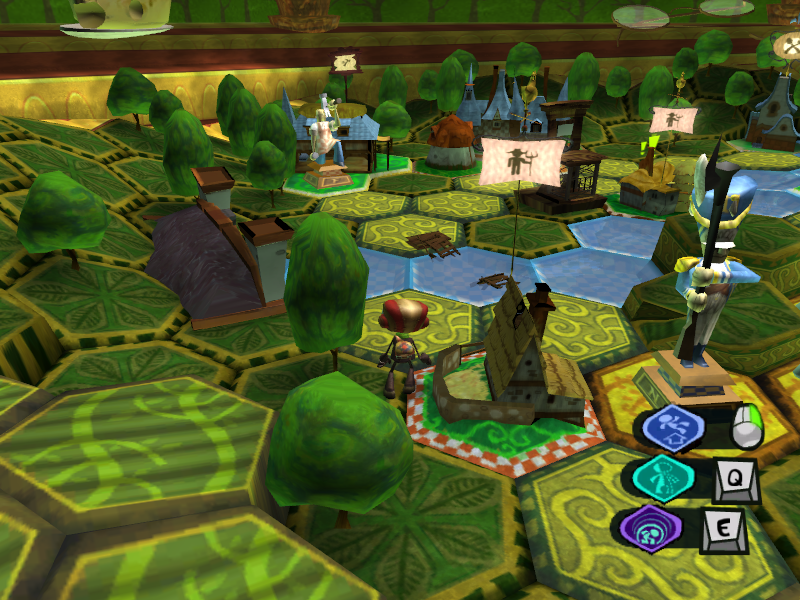
Brain Diving Catan!  I would play an expansion like this.


I think this issue may come from the fact that people started using "atmosphere" as a way to define horror games.  They wanted a word to explain a feeling of tension. Look back at Resident Evil 1.  The game was really bad in terms of controls, but everything about it was tense.  Look at Silent Hill 2, a game almost universally praised.  The fog added uncertainty, and made you paranoid.

Looking at this, we can redefine atmosphere as such: The feeling of "what the hell is going on here?".

Sure, games have uncertainty in them.  If they were predictable, you wouldn't want to play them.  games that have great atmosphere though, they affect you at a deeper level.  It becomes a morbid curiosity.  You want to know more about what's going on, but you're apprehensive about what's coming up next.  When you're in this state, everything becomes more effective.


Now there's one other game I want to mention (again).

No!  Not you!

The game is Vampires: The Masquerade Bloodlines.  I touched on this before in my last post, but I felt like it needed repeating here.  I think what helps draw me into it, personally, is the minimalistic background music when you're not in nightclubs, or around radios.  It's very simple, but haunting enough to keep you focused.  This game is like Bioshock in that it makes it's own world feel alive, in a sense.  You hear a radio DJ taking phone calls at night and you can read random emails that have no bearing on nothing whatsoever, but these things are important for world building, which, in turn, sucks you into that world.  

So, those are my thoughts on atmosphere in gaming.  I think the term gets used loosely a bit too much.  I feel like it's more akin to tension, but what do I know?  I just write on a random blog for fun.  Feel free to make your own interpretations of the word.