Pages

Sunday, June 17, 2012

Persona 3 Review

I discovered this game through a Game Informer review of Persona 3 FES back in 2008 or so.  The concept of the game intrigued me.  I started off by renting the original Persona 3 a month or so later, and eventually, bought FES new.

So, what is Persona 3?  Well, for those unaware, it's a JRPG of the Shin Megami Tensei brand which was published locally by Atlus for the PS2.

The premise of the game is that you, the silent protagonist, knows that the world will end in exactly one year, and no matter what action you take, you take full responsibility for it (comes into play towards the end).  Nobody else is aware that the world will end either.
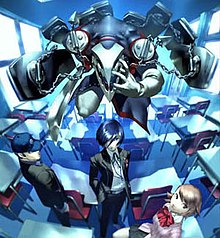
From left to right: Junpei, Main Character, Yukari.  Above: Goddamn Thanatos.

Keeping with traditional JRPGs, you play a high school aged character, but you actually have to go to school during the day, hang out with friends after school, then kill bad demons at night in the twisted recreation of your high school.  Totally normal.

Alright, so to break down the game itself.  It's divided into two main parts: Day and Night.  During the Day period, you go to school and can hang out after school with a variety of people to bolster your "Social Links" (a little more on those later).  During the Night period you can either go out to the mall to boost some stats/find specific people, or go to Tartarus, the twisted remodeling of your school, to fight the Shadows.

This division of your day is pretty neat.  Building up your Social Links is beneficial towards exploring Tartarus.    Every person is assigned an Arcana, based off the major arcana from Tarot.  For example, the main character is of the Fool arcana due to it's potential (Fool's number is 0).  So, as you form Social Links and level them up, your ability to fuse Persona, the powers you summon from within, improves.  If you have a high ranking in the Chariot Social Link for example, when you make a Chariot Persona, it'll get a huge amount of XP upon creation, leveling up several levels.

So that's the general mechanics on the game.  Right now I'm devoting a whole section to the soundtrack.

Seriously.

The soundtrack is pretty interesting because it emphasizes the contrast between what goes on during the Day and Night periods.  The soundtrack has an infectious vibe to it.  The day time music is really light, peppy, and relaxing, whereas the night-time music is more upbeat and at times, intense.

This is what we call a fun boss theme.


That's the theme for a few different boss fights, whereas this...


Is the regular fight theme.  You'd think this wouldn't work, but damn, does it it infect you.  It's one of those fighting themes that can stick out during a fight, and can blend into the background at the same time.  

Now, if we compare this to your after-school music...


This is what we call contrast folks.  It's a pretty big theme in the game.  Contrast between day and night activities, persona abilities, music, and even among the characters themselves.
Atlus pulled some pretty good talent to do the voice work for this game.  Notable voice actors include Vic Mignogna (Full Metal Alchemist, Disgaea 3, other roles), Michelle Ruff (Bleach, other roles) Tara Platt (various roles), and Liam O'Brian (Final Fantasy XIII-2, other works).

Atlus seems to have a track record for bringing games stateside that people want, and for doing a damn good job of it.  I haven't played Persona 4, but I hear it's another great game that was localized well.

Atlus: Giving your great RPGs since 1986... except the ones that sucked.  Ignore those.

Alright, now I'm going into rambley land.

Combat in person is pretty simple.  You choose whether to attack with your weapon, or to summon your persona to use a skill.  Casting physical skills does some HP damage to you, while magic skills use your SP.  Simple.  in addition, you can only control the main character (in P3 and FES, all characters in P3P).  If the main character dies, it's game over.

Done.

Fahgeddaboudit.

Also, the game takes advantage of some "elemental Rock-Paper-Scissors".  While you can change your persona (even in battle), and thus, change your strengths and weaknesses, your NPC allies only have their one persona to work with.  

Starting Persona, with stats somewhere between "Jack" and "Shit"

The resistances are groups into physical and magical.  The first three are "Slashing", "Bashing" and "Piercing".  The second group is: Fire, Ice, Electricity, Wind, Holy, and Darkness.  As you can see, Orpheus is weak to Electricity and Darkness type attacks.  This means that if I get hit with an electric type attack while having Orpheus equipped means I take extra damage and I get knocked down.  This is detrimental because to stand up you either need to be hit, healed by an ally, or spend your next turn to stand up.  

You can also use this to your advantage.  If an enemy is weak to a type of attack, you can knock them down.  You can also knock an enemy down with a critical hit as well.  If you knock an enemy down, you get an extra turn, which can lead to knocking down all enemies.  If this happens, you and all allies will bum-rush the group of baddies, dealing a good amount of damage to all of them.  This makes it a good tactic to speed up the level grinding process.  

Another nice feature is the equipment.  While it has almost no cosmetic changes, save for a few pieces of armor, the main draw is that each weapon, accessory, and armor has a unique attribute.  For example, if you find two pairs of shoes that are the same in name, they'll both confer the same stat bonus (i.e. 12 Evasion), but their unique effect may be different (Dodge Electricity: Medium Chance vs Critical Chance Up: Low).  This makes managing your equipment a little more interesting.  You may give an NPC a certain piece of equipment with lower stats, just because it helps neutralize their weakness.  

Some other negatives about the game is that it can be repetitive at times.  You need to be able to put up with the mandatory level grinding in order to be able to beat the storyline missions.  Also, you should keep a manual calendar of your Social Links if you want to max a lot of them.  Some only meet on certain days, so you'll need to take that into consideration.  

So what's the difference between the three versions?  Well, there's a couple.  Between Persona 3 and FES, you gain new Persona, new Social Links, updated dialogue, a "Hard" difficulty (Seriously, this sucks.  Enemies hit harder, and their status effect attacks hit you more often), and a 30-hour Epilogue.  From FES to P3P, you gain access to a New Game + option, a choice of Male or Female Protagonist, which changes the Social Links around, and I'm not sure if that includes the bonus chapter...

Female and Male protagonists


All and all I'd recommend this game to people who like JRPGs.  The story is surprisingly dark at time, but is often contrasted by some humorous writing and voice work.  If you can put up with the level grinding, you'll find that the game has surprising depth to it.  The cutscenes, though few and far-between after the start of the game, are well done.  

You can find the game at various GameStops for new or used, or grab the digital version off PSN for FES.

Monday, June 11, 2012

All The Small Things...

This is a trickier topic to fully pin down for me.  It's one I've been tossing around for awhile, but haven't found a complete way to explain, so this may ramble a bit.  

There are little things, usually insignificant on their own, that can make an average game good, or a good game great.  These small things can be anything from an easy way to catch up on the story, or even some game mechanic that you won't be required to use.

I've been playing Red Dead Redemption lately, and I've been enjoying it more than the other major Rockstar franchise, Grand Theft Auto.  RDR is varied in what it offers you.  The game offers randomly generated mini-activities like getting your horse stolen, someone robbing a store, or getting jumped by bandits, that add a lot to the world.  These events can happen at many locations, so it feels like the world is alive.  Another thing that I discovered made the game, for me, much much better.  I discovered I could pull people off horseback using my lasso and drag them behind me as I rode my horse.  Have I needed this for a mission or quest?  Nope!  It's just one of those little touches that makes me smile.  I dragged a guy through main street of one town on a whim, just because I could.  

Giddyup!

Another game that I feel just has these little touches is Persona 3.  In Persona 3, you can view a compendium, which allows you to recall Persona you have used or owned previously.  That's the function of it, but this is where one of those little perks comes into play.  In the compendium, you can see a little history of the persona. For example, you can read about the origins of Orpheus, from Greek mythology, or learn a little about Odin, of the Norse culture.  

"I do believe impalement is my favorite way to kill someone"

Another popular one is continuity nods.  If you're playing a game in a series, it's always nice to recognize lines, items, or events that make call-backs to previous games, even if they aren't related.  

This is a tricky topic to write about because it's so subjective.  I usually try to write in broader terms, but today I felt like indulging on a whim.  Plus any excuse to talk about Persona is fun.  


EPIC FORSHADOWING

Yes, this means I'll be doing a review of Persona 3 here in the near future.  If there's any series you want me to look at or write about, or any subjects you have questions about, feel free to let me know, either through the comments or other means.

Saturday, June 2, 2012

Artist Showcase: Devin Townsend, Part 1

Devin Townsend. Where do I begin? This is a musician who's been all over the place throughout his increasingly-large discography, and no matter which genre of music he attempts next, he performs it with the same perfectionist quality and attention-to-detail that'd be expected of the masters of the genre. So, let's start from the very beginning.


NOTE: Even though Devin Townsend has had many guest appearances and helped out with other albums in small ways, this Artist Showcase will focus only on the ones that the Dev had a major role in, and will be listed in chronological order. Sorry, no love for Front Line Assembly in this post!

STEVE VAI - SEX & RELIGION


So, when Devin first began his initial foray into the music industry, he was but a strapping young lad (I MADE A FUNNEH) of the tender age of 21.

He was awfully ambitious for his age.

 Devin performed all of the lead vocals on the album, and does an astonishingly good job at it as well, with his work on this album being home to some of the highest notes on his recorded vocal range to date. On some songs, like Touching Tongues, he showcases a bit of Freddy Mercury influence, and on others, he embarks on a style wholly his own. Though not flawless, Devin's vocal delivery on this album is stellar, and a promising hint on the rest of his vocal work to come.

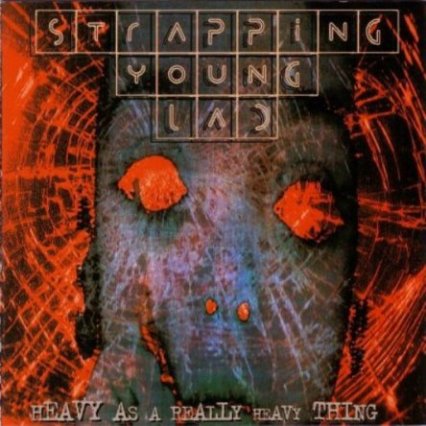
STRAPPING YOUNG LAD - HEAVY AS A REALLY HEAVY THING


Disillusioned by his experiences with the music industry when he was with Vai, and his constant rejection from various record labels during his short-lived stint as the guitarist for a British hard rock group known as The Wildhearts, Devin decided to turn his anger into a productive outlet, and formed an extreme metal project named Strapping Young Lad. Heavily inspired by extreme and industrial metal (more specifically, Fear Factory's debut cut Soul Of A New Machine, which blended industrial and death metal), Devin set out to record this album, not for any perks for himself, but solely as an elaborate joke at the expense of the music industry, one of the album's prime targets lyrically. Although the album was the product of sheer angst and anger, it never took itself too seriously, beginning a trend of subtle (and not-so-subtle) self-referential humour that would persist throughout the project, and even through Devin's solo material. The album was mostly a solo effort, but was performed with the aid of Adrian White of Front Line Assembly on drums, and Jed Simon on backing guitars. Jed Simon would remain a part of Strapping Young Lad throughout the project's lifespan. 

THE MOST IMPORTANT THING YOU WILL EVER SEE

This album also marked the beginning of Devin's trademark wall of sound production, inspired by Frank Zappa, but with his own over-the-top flair to it, and with an almost perfectionist quality to it. Each background noise, every frequency had its own special place within the song structure, a trait which would carry through even today. The album lives up to its name, as the songs are unceasingly brutal, aside from a few entirely tongue-in-cheek sections, such as the bonus track, which at first glance seems to be too happy for its own good... One problem with the album, however, is that it was very much an album to be taken as a whole, focusing on the general intensity and sentiment of the album as a whole, rather than individual songs, although the album did have a few hits. Heavy As A Really Heavy Thing is one of the more underrated releases in Devin's catalogue, some would argue rightfully so, including Devin himself, but the sentiment remains as relevant as ever, especially in today's world of cookie-cutter pop artists and exploitation. 


PUNKY BRUSTER - COOKED ON PHONICS

With a band name and album title like that, you can tell that this is going to be the darkest Devin Townsend work yet.

Punky Brüster was a one-off project helmed by Devin and brought to fruition with the help of Adrian White, fresh off of his previous work on HaaRHT, and John Harder on bass. Continuing the trend of jokes at the expense of the music industry, Cooked on Phonics tells the tale of the death metal band Cryptic Coroner, from South-Central Poland, who decide to sell out and become a punk band. The entire album was a jab at sell-outs, the very nature of selling out, and the general absurdity of the music industry. The music was played in a typical, almost parody-ish punk style, with the story being told through the lyrics, and occasionally through a narrator. Much like Heavy As A Really Heavy Thing, the album was much more about the general concept rather than the individual songs. Punky Brüster is another oft-overlooked entry into the Devin Townsend discography.


Welp, that wraps it up for this first entry in the Devin Townsend Artist Showcase. The next part will kick off with the section of Devin's catalogue where the real gems start showing up. Good times!

Friday, June 1, 2012

Bigger Than Doom: A Source Port Rant

Only two things come to mind when I say Doom. Kick-ass, classic gaming near and dear to my heart, and that shitty movie starring The Rock.

What the fuck is this thing?
Now I love me some Doom... my first post had Doomguy in it. My avatar is Doom. I fucking love Doom. However, it hasn't aged well in my eyes. Back in the 90s I had a blast with it, installing shareware copies on my aunt's and uncle's Compaq's and Gateways, because hey, they had the money to afford a PC back then, and I was only like 7 or something. I can't remember that well. All I know is you ain't working a full time job to save up for a PC at age 7.

You're probably doing this instead.
Anyway, what I'm trying to say is, I played regular, old blood and guts Doom, and I couldn't do it. It hasn't aged well enough. I'm not playing on a Gateway from 1998, but a HP from 2009! It's time to update! Especially with Doom's source code available to the greedy public. What resulted was something that literally saved my love for Doom.

Wednesday, May 30, 2012

Podcast 02: MMOs

So we've got another non-news podcast for once!

Aander91 and myself have a chat about the differences in MMOs and our takes on the genre.

Topics include...

Open-world vs Instances
Mid-Game Grinds
End Game Troubles

And more!

Just hop on over to the Podcast tab to have yourself a listen.


Obsolete content, a curse and a blessing

So I just played WoW for way too long, it was grindy and repetitive, but my God, this game offers an experience like no other. You know when you play a game that you get so invested in that you can't stop thinking about it? It's something that goes beyond the gameplay, you get an emotional attachment to the environment, characters, and story, and everything comes alive. I found myself questing in Silithus, and generally I'd complain about having to kill 20 stupid things but this time I had no quarrel, the area is just so rich in content.

Upon seeing Silithus, you might be confused. It's not pretty and it seems pretty straight forward. It's a desert with bugs, but there's something special here and I'm not sure any other game has or has even been able to accomplish. The area feels old, and not in the lore sense, but this area is outdated. There are items and quests that are simply relics of a time passed. Most notably Silithus boasts something that WoW hasn't really had for a while, and those are World events. As far as I know (since I started playing mid-Cata), this was the first or at least one of the biggest vanilla world events. There is a gate at the southern end of Silithus (which also marks the edge of the continent, which was off limits before flying was brought to the old world) that only opened once a bunch of players completed a bunch of absurdly lengthy quest lines. Upon completing this they were able to open the gate, which spawned a bunch of giant bad guys and allowed the server population to run new instances.

Now the gate stands open, and the gong which triggered the opening is still there, but there's no players around, and the raid content that had once been the talk of the town is now ignored. It's kind of sad, but at the same time it works with the original game design. In the lore, Silithus bears the scars of a war fought eons ago, and in reality, the content tells the same story. The parallels open a doorway to a new sense of immersion in the game world, as I can relate to the content that I have missed with the actual lore, and it makes it all the more real.

Sunday, May 27, 2012

Final Fantasy: A Retrospective (Part 5)

Now for the final installment!

In this one I'll cover Final Fantasy X and Final Fantasy XI. I'm not touching X-2 (Haven't played), XII and XIII (Too recent for a "retrospective").

Final Fantasy X (2001)

Final Fantasy X marked the series transition to the next generation of consoles.  The game took advantage of the PS2's vastly superior hardware to produce full 3D effects (as opposed to the ones seen in the previous games) and incorporated near-full voice acting.  Due to the player being able to name the main character, some scenes weren't voiced due to this.

Just gonna get this out of the way riiiiiight now.

Corny moments aside, this game made a few interesting strides in terms of gameplay.  The Sphere Grid system replaced traditional leveling.  As you gained enough experience points, you gained "Sphere Levels", which allowed you to move along a grid.  You could activate the space you were on, and spaces adjacent to you if you had the appropriate spheres in your inventory.  Now, at the start, each character was on their own path, so they were distinctive (Auron had a lot of HP and Attack spaces, Tidus had Speed and Evasion spaces), but if you used the right special spheres, you could jump into someone else's grid, or learn an ability they learned.  It was a different approach to leveling up your character and was kinda fun in my opinion.  

The next gaming convention was a slight modification of the Active Time Battle (ATB).  In past Final Fantasy games, your turn order was determined by a filling bar on the side that filled faster if you had higher speed.  In this game, the bar is gone, but you have the same concept.  The turn order is displayed on the side, but certain moves (Tidus' Quick-Hit for example) would make your character's next turn come sooner.  Other moves had a chance to delay an opponents turn as well.  In addition to all this, you could switch out your party members mid-battle if one gets hurt, or you need to switch from melee to magic.

The game also allowed you to customize equipment.  Unlike previous games, two weapons of the same name could boast different stats.  If you have a sword for Tidus, for example, it could have 3 slots.  They can either be pre-determined with some abilities, or empty, waiting for you to fill them in.  If you have the right materials, you could make a weapon that does more damage (Strength +5%) or poisons your enemies (Poisontouch).  This, paired with the ability to change gear mid-fight meant that you could switch to a specific piece of armor to fight off an incoming elemental attack, back to your other piece of defensive gear.  

Also in this game, summons (called Aeons) are only callable by Yuna, the female protagonist of the game.  The nice thing about them is that they're controllable, unlike previous "Summon for big attack, then leave" summons of previous games.  The Aeons can have their stats improved and abilities can be learned the same way you customize gear as well.  This means Ifrit, a fire element Aeon can learn Blizzaga, a strong Ice Spell, which would make him very useful against fire-type enemies since he would receive minimal damage, but do massive amounts in return.  Aeons also have their own Limit Breaks, which allows them to deal massive damage to all enemies.

"This is my Ass-Kicking pose"

The story can be a mess at times, and the main minigame, Blitzball (or as one of my friends affectionately calls it "Drown Ball") can be hit-or miss for people.  Overall though, it's a solid entry into the series and is pretty fun to play.  


Final Fantasy XI  (2002 PC/PS2, 2006 Xbox 360)

Final Fantasy XI was Square Enix's first MMORPG, and predates World of Warcraft by 2 years.  Now, what this game does is... well, a lot.  It offers 5 playable races: Humes (general all-around stats), Elvaan (Tall elf-like, good Warriors), Tarutaru (Smallest race, cute, strong with magic), Galka (Strong bear like people, good Strength), and Mithra (All female race of agile cat-people... This is Japan after all.).  There are also 20 different Jobs (classes in other MMOs) that you can play as, but only 6 are available at the start.  Unlike other MMOs, you can switch your Job at your "Mog House", which acts like a safe haven of sorts. 

 Until you hit level 30, you can only be a Warrior, Monk, Thief, Black Mage, White Mage, or Red Mage.  Upon reaching that milestone, you can undertake quests to unlock the other 14 jobs, which include series staples like Ninja, Samurai, and Dragoon.  Not all the quests are easy though.  Some you can undertake at 30 by yourself, others, you may need a party of 6 at level 50 to unlock a job.  

In addition to being able to change your job to fit your mood, you can also synergize your Job by having a sub-job.  Upon reaching level 16, you can do a quest to unlock the sub-job ability.  This allows you to equip a second job.  You would get all the benefits of the second job up to the level cap of 1/2 of your main job.  For example, if you have a level 10 Warrior and a Level 10 Monk, going Warrior/Monk means that you'd be a level 10 Warrior, and a level 5 Monk.  But if you also had a level 2 Thief, and went Warrior/Thief, you'd be a level 10 Warrior, and level 2 Thief still.  The subjob doesn't bump up levels.

This system plays out nicely overall.  If you want to kill for items (farming), you could go Thief as a main (for the Treasure Hunter ability, which helps drop rates), and sub Warrior for extra attack and defense.  This sort of  hybrid gameplay made the game feel fun.  When I played the game solo, I'd want to unlock other jobs just to try other combinations.  Of course, as in any MMO, there's a generally perceived "Right" way of doing your class-subclass combo, but still, it's fun to experiment.  

There are three starting areas, which are major cities in the world.  in addition to doing missions for them to progress the story, you can switch your citizenship for a fee.  You need to make it to the city and go to their embassy, and request a change of country, and BAM, now you can do their story missions.  There's a LOT of content in this game, and a lot of endgame stuff I've never even played.  

This is not a very PVP-centric game.  There's passive PVP in "conquest", which basically amounts to "kill monsters in this zone with your country's sigil buff active, and help them take over".  If the monsters kill a lot of Players, the Beastmen take control of the zone, which means that there's no real PC help in that region.  If your country controls the area, you can buy some simple items from the outpost, and deliver Outpost supplies, which allows you to warp from the region to your home country, and vice versa.  

STAY AWHILE AND LISTEN

The soundtrack is pretty good, not just by MMO standards, but by game standards.  Series veteran Nobou Uematsu had a hand in helping with the soundtrack, which showed in the quality of the music.  

This game is still going today, albeit with a smaller fan base.  The strong PvE endgame are good reasons for this though.  The community is pretty open and friendly.  The graphics are a little dated, and the combat may feel slow at times as well.  The game is still receiving new content over 10 years after release, which is astounding.  Once this game goes free-to-play though (if it does), you can be certain I'll be diving back in for another go.